Tuesday, June 18, 2024

Learning the Dude Sign Language

The Dude really prefers the signs he has worked out to communicate, rather than using ASL. We have tried to get him to use ASL to no avail. So here is a lexicon to convert Goobear Sign Language (GSL) to English.

Sign

Means

I, me


See, saw; sometimes remember

God; sometimes space (pointing straight up)

Hell, the devil (pointing to the ground)


Movie (looks like he's holding a VHS tape and pushing it into the player)

Bed, sleep, lay down (right hand only)


Home Alone (tries to get both hands up to face like Kevin when he yells after applying aftershave)


Star Wars, Luke Skywalker (index and pinky pointing forward to imitate X-wing flyer)


Looks like (points to eye or swipes hand down face)   


Glasses (points right eye as if holding glasses to face)


Chocolate (holds R hand to form letter C, rubs it on back of L hand)


Sunday, January 1, 2023

The Testimony of Someone Special


Hi. My name is Brad Bush. My mom set up this web page to help me.

(This is me. Of course Mom had to choose a picture of me sticking out my tongue. Silly Mom.)

To understand my story, I need to share some history. I was a normal kid like everyone else until the age of 10. Then, in July 1995, I was in a car accident and was hurt badly. I stopped breathing long enough to cause brain damage. 

I spent two weeks in a coma. When I woke up, I couldn't move anything by myself except my eyes. I spent months in rehab, but came back home and went back to school. I can do some things by myself, but I can't talk because I have damage to the nerves that control talking. This is why I asked my mom to put up this page. Chances are, you came to this page because Mom put a QR code on my tray. This gives me a chance to tell you some things that I can’t easily do in person.

I love, love, LOVE talking about Jesus. Why? Because when I was in my coma, I went to heaven and saw Him. My story hasn't changed since I first told Mom. 

Jesus  took me to heaven so I could see how wonderful and amazing it is. I got to see a lot of people. But Jesus also took me to see hell (years later, in a dream) so I could understand just how bad it is. And let me tell you--hell is the worst possible thing and you can't imagine how bad it is.

I want to tell everyone about this so they will understand this, and I want everyone to go to heaven. How do you get to heaven? You just need to believe that Jesus is God’s son and He died so you could live. You have to trust him to make all your decisions and recognize that He is in charge, not you. 

It’s easy to say, but it’s hard to live out. I don’t get to do everything I want because of my brain injury, but I know that Jesus is always in charge. And knowing Jesus is better than anything else. I know I will be able to walk, talk, and run again once I get to stay in heaven. And I want as many people to come with me as possible. 


Sunday, May 4, 2014

Beware, with fear and trembling, for the monster awakes

I have not posted on this blog for four years. There are many reasons for this, and many reasons why it doesn't matter.

But fear me, for I shall attempt to take up the blogging pen again.

Why am I doing this? That is an excellent question. I'm not sure I have an excellent answer. Part of it has to do with the muse awaking in me, crawling and begging to get her thoughts out somewhere, anywhere. Part of it has to do with having a place to write down big, long arguments so I can get them out, try them on for size, see where I have left big, gaping holes, etc. Part of it has to do with me looking at the tech industry and seeing .... a whole lot of nothing.

Lately I have been less than impressed with what is coming out of the tech industry. Oh, I have read numerous posts about the Internet of Things, and I cannot help but think, over and over again, "This company is trying to sell a product as new and improved by adding a network port, some programming, and that's it. The base product itself hasn't changed a bit."

I am not saying that innovation has died. Far from it. But I haven't yet seen much that has made me be very impressed with any company. Or any product.

Let's take my favorite punching bag right now: smart watches. I want to go back and look at the genesis of watches and how they became the ubiquitous tools they were for several decades, but I am not yet in a position to do this. And as much as I admire Pebble for making a first stab at smart watches, I cannot help but think: all these things are are pared-down phones or gussied-up speakers. Some of them can make phone calls. Some can read emails or text messages. But none of them are doing what the iPhone did when it first came out: combine several devices into one holistic and useful unit. Instead, now we are pulling features out of a product and trying to make it fit on a wrist. Why?

Let me answer that with a bit of my own experience. I wore a watch for decades. I loved having a waterproof watch when I was swimming, and I needed to make sure I was where I needed to be when the children depended on me for transportation, food, and help for homework. Being able to simply look down at my wrist and verify the time was useful.

Now, like many people, I don't have a watch. I use the cell phone in my pocket. But I see one big drawback to this: I get very tired of having to pull my phone out of my pocket every single solitary time I need to check the time. It takes far more effort, as compared to just looking at my wrist. And apparently a lot of folks are having the same experience--otherwise, I don't see why there would be this rush to bring back the watch.

But having a watch that is just a watch and just tells time seems lame to us now. Before the smart phones, watches started adding stopwatches, alarms, and timers to make them more useful. We do all these things now with our smart phones. So we are trying to make watches smarter as well. We want to use them to track fitness, alert us of alarms we have on our phones, and warn us of that urgent text that must--must!--be seen immediately.

But functionally, it isn't the fact that we want to tell time that is pushing these new breed of watches--it is the real estate on our arms that is currently unused and, once, was a useful place to store necessary information, like the time. There are many people like me who want to have smart devices but get frustrated having to take them out of pockets constantly in order to access the information. So the thought is to return a form factor that we recognize--the watch--and repurpose it to add more gadgets and gizmos rather than just an alarm.

In some respect, this is what Google Glass is doing as well. It is taking advantage of unused real estate on our face and before our eyes and using it as a way to make that information accessible without having to pull items out of our pockets.

So the problem here isn't the watch, or Google Glass, or anything like that--

The problem is where our devices are residing. In pockets, hidden.

If we could somehow always have our devices in some area of our visual space without having to reach into pockets or purses into order to grab them, it would be a huge win for everyone who wants it.

So how can we do this? Right now, I have no idea. In some ways I think Google Glass is creating a portable heads-up display, and I think that addresses some of these issues. But there is already a bad rep developing for Google Glass and the glassholes who wear them. That's a problem. That tells me that we don't want the tech to be that visible.

Having contacts that embed a display device in them sounds like a better solution--you can see what is going on with your device, but no one else can and no one can tell (without getting a little too far inside your personal space) that you have any device on. That sounds like a better solution, but there are many folks like me who cannot wear contacts. So it won't work for everyone. Now a few more interations of Google Glass, and we may reach the point where the technology is also hidden and you can't tell it's there. But that isn't the case now.

Part of me cannot help but think of the full-arm device that Chuck's father wore in the TV series Chuck. Played by Scott Bakula, he had a device that was really a miniature computer (this was the early part of the 21st century, recall) that was worn on his forearm and took up all the space between the wrist and the elbow and had a tiny screen in it. I don't think that is the solution.

I don't think Siri is a solution, yet--not until we have earpieces that allow us to hear Siri alone and vocal processors that allow us to talk without making a sound, and thus avoid irritating all the folks sitting around us on the bus and subway. (Don't get me wrong; I love Siri and other voice interfaces, even when they misunderstand me. But I really hate talking about private stuff in public.)

So somewhere, somehow, there is room for improvement in all this. So far, I'm not convinced the watch is the way to go.


Sunday, December 27, 2009

Ipod Touch App Review: Asthma Journal Free

I have never hidden the fact I have asthma in real life, although I doubt I have mentioned it in this blog. Being a geek and a chart nerd, I regularly take my peak flow and chart the results, watching my results daily, weekly, and monthly to see how I'm doing with my lungs.

So while I was perusing the iTunes Application Store, I thought I'd see if there was anything I could use to chart my numbers, rather than use paper and pencil. You know, if I can save a branch, why not?

I ran across Asthma Journal Free, and thought it was worth a try. Asthma Journal free is published by Ringful LCC, which appears to have several medical professionals affiliated with it based on its web site.

Pros:

  • It's free.
  • It not only allows you to track your peak flows, but also medication use, symptoms, sleep patterns, and activity levels.
  • You can, if desired, connect the results to Google Health and Facebook.
  • You can discover the latest news on asthma.

Cons:
  • You have to create a new journal for each day, so consequently you have to jump through quite a few screens: set up your journal, then go to a new screen to check of symptoms, meds, sleep patterns, then jump to a new screen if you want to enter your peak flows (granted, it's just a number pad, but the developers could have made it so you just entered the data on the same screen using the regular text entry methods).
  • Charting options (which I really love) are only available in the paid version of this app. I wish at least basic charting of the peak flows would be available in the free version.
  • I'm not sure that knowing the latest news is really that helpful, as I doubt many doctors want their patients to change their medications or treatment plans on their own. I would rather have such news filtered through my doctor, who is far better able with his training to determine the value of the research or paper in question.
  • While being able to send the information to Google Health or Facebook is fine, I'd really like to have the ability to download the data to my Mac and be able to see the data in table format. I appreciate the value of electronic records, but I have serious reservations about keeping my data private given the problems already demonstrated with Social Security Numbers, financial data, and more being leaked to the Internet. Intentionally putting it on the Internet in Facebook (which is all about sharing information) or Google (which is the biggest search engine that intentionally searches out information) seems ridiculuous. Right now, I have no way to really see this data on my computer--only on the Touch.
I've only used this app for two days, and while I will continue to use it, it isn't perfect. Rating: 3.5 out of 5 stars.

Saturday, December 26, 2009

Time for new technology

While I refuse to spend money for a cell phone, I did receive an iPod Touch for Christmas. Maybe I'll actually start posting again.

Saturday, June 27, 2009

The Running of a Country

I heard this originally at Michelle Malkin, where she was liveblogging yesterday's climate change bill, technically known as HR 2454 or the American Clean Energy and Security Act and colloquially known as the Waxman-Markey Bill:

At approx. 2:35pm Eastern, GOP Rep. Joe Barton announced that there is now a placeholder in the bill to be determined later. Barton notes that this is unprecedented. He can’t recall any final passage of a bill that has a placeholder in it. What the hell is going on? This is deliberation? This is transparency?

So I spent today trying to figure out what this "placeholder" was. From a quick perusal of the Google results of "climate bill placeholder", it appears that several placeholders had been in place earlier in the bill:

  • the creation of a NOAA-centered service called the National Climate Service
  • details on "allowance allocation", which I haven't found defined
  • items put in by Barney Frank that are considered placeholders
So parts of the blogosphere are talking about "placeholders" without clearly defining what the heck they mean by it. That's bothersome to me, as I would like more information on this.

But it is bothersome--regardless of what the supposed placeholder is--that the House would pass a bill that is, in essence, incomplete. If the bill is passed by the Senate, it will no doubt need to go to conference to rectify the differences between the Senate and House bills. Perhaps that is where said "placeholders" would be clarified. But somehow I severely doubt that.

Given the fact that representatives have had to deal with 300-page amendments coming one day before the final vote was cast, it is clear that our elected officials are not the one ruling our country. It is the billwriters, who are often the special interest groups.

It is a sad day in the United States.


Sunday, May 17, 2009

The unseen face of Wolfram Alpha

I haven't had much time to play with it yet, but I did run across this. Someone at Wolfram has a sense of humor.


Netbooks, Kindles, and iPhones, Oh My!

With the release of the Kindle 2 and the Kindle DX in the last few weeks, I've been thinking seriously about how E-Ink machines compare to netbooks and smart cellular phones. This article by Hadley Stern does a comparison and says the following about one syncing service, .Mac:
.Mac and other technologies is the first step in this vision. It allows my iPhone and my other Macs to stay in sync with bookmarks, keychain items, email accounts, and more. But what I'm talking about is a quantum leap beyond the closed and limited experience of .Mac.

In this new world my digital world follows me around from device to device completely. Whether I am using a public computer at a hotel, a computer in a hotel room, or watching TV at a friends house, flying on a plane with a screen in the seat, these devices will adjust for who I am just by walking in the room. My user profile, documents, desktop, everything will just appear.
Or, as I would state it, with cloud computing, the actual device I use to view the cloud doesn't matter: so I can use anything and just keep my information in the cloud, sync'ed with a few devices.

Here's my analysis, using Hedley's as a starting point. It seems people want the following feature sets on their "smart devices":
  • Color screen
  • Access to cellular service
  • Access to the Web
  • Ability to play some form of entertainment: movies or music or games
  • Ability to type to send emails, write up notes, etc.
Can one device do all these things and not require a lot of power?
  • A color screen requires an LCD right now. Everyone agrees that until E-Ink has color it won't be widely adopted. But it sounds like researchers are starting to make headway on this problem. If color E-Ink comes down the pipes for a reasonable price, the various devices may merge. The key here will be: what size screen do you feel comfortable with?
  • Cellular service is starting to be ubiquitous with Internet service, so we may get to the point that having one means having both, automatically. Skype service on an iPod Touch may cover everything you need. But speed is still an issue.
Entertainment options may be the limiting factor.
  • Movies on the Apple Store, Amazon, Netflix, etc. to rent or buy limit the need for an external DVD player or the need to hook up your device to a desktop machine that has one. But:
  • If you want to watch movies, downloading them over the 'net isn't a viable option without a high-speed connection, so that would require a DVD drive on most devices (or, in the case of an iPhone, a desktop machine that can read the DVD and move it over to the phone).
  • Music can now be delivered via Pandora or Imeem, so you don't necessarily need a large drive to hold your music on your favorite device. You do want a place to plug in ear phones, though.
And what about text issues?
  • While today's twenty-somethings are comfortable texting on cell phones, those of us in the older generations aren't. So that means a QWERTY keyboard, and that automatically requires a specific size.
  • Email is a nonissue now, it appears. You can get email anywhere.
  • The one thing most people don't think about doing on their desktop computers is reading text. Often that was a problem with eye strain. But would you jump for the chance to carry 80 pounds of books on a machine that weights under 20 ounces? Maybe in college, but there seems to be little need for it outside of education except for a few fields: medicine, law.
But I fear that we may see pressure from another venue that hasn't exerted much force on the computing world until now: the environmental movement. I'm seeing a lot of professional rags starting to talk about "green computing," and this may force our hands away from devices that suck a lot of electrical juice and move us to E-Ink where the power usage is minimal.

And it doesn't seem to be the habit of some people to simply stop and plug in their cell phones each night--so something that doesn't require that power connection constantly will be a welcome change. Would government get into the act and require that these devices use less power? If we continue to have brownouts and power dropoffs, we may be forced to adopt serious changes to the devices we use.

Right now, I'm seeing the following model evolving further: most people will have a computer for use at home, either as a laptop or a desktop machine, which will continue to be the hub of the digital life. Then they will have one, and just one, device to provide access to the digital world away from home. Both devices will be expected to be smart energy-saving tools.

Today, some folks may be willing to carry a laptop, a work cell phone, a personal cell phone, a portable DVD player, and a digital camera and all the power cables to power these devices. But people are going to get tired of this and will want one device to handle these needs when they are not home.

Saturday, April 11, 2009

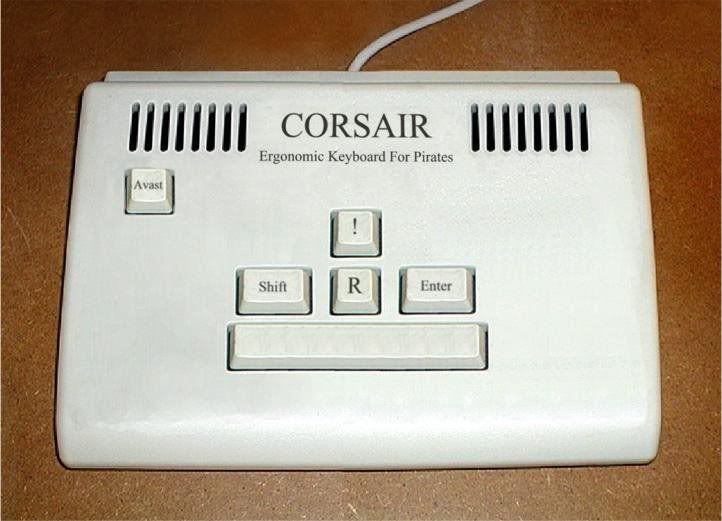
Keyboards for Pirates


At:

http://i30.photobucket.com/albums/c340/davemarkowitz/pirates/pirate_keyboard.jpg

Not to make light of the fact that pirates have hijacked a ship with American citizens, the pirate keyboard is a bit of fun.

We are getting stupider

At least, with regard to science. Junk Food Science quoted this report early last year that shows appalling statistics on what we think we know about science. And while this has been out for a while, I want to go over it again.

First: What was the purpose of this report?
The new report “Science and Engineering Indicators 2008” has just been released. This is that biannual report by the National Science Foundation’s Division of Science Resources Statistics under the National Science Board that reveals the state of science education, research and development trends, health of the science and technology industry, and the understanding of science among children and adults in the United States.
So the purpose of this report is to just determine where we stand in terms of education for America's kids and how adults interpret science, at least as of 2006. Right? But please note:
Being a collection of surveys, the report cautioned readers that some of the information is “subject to numerous sources of error and should be treated with caution.” Remembering these are survey results can offer insights into some of the seeming inconsistencies in the findings. What people say and what they do, or are able to do, sometimes differ.
So while we may find some insights in this report, we must be careful how we apply the results of this study to the entire population of American students.

So let me summarize the results here, if I may, as percentages:
  • Adults who said they closely followed science and technology news: 15
  • Compared to other topics: science ranks after all of these: weather (50), crime, community, health, sports, government, Washington news, international affairs and religion
  • Adults who said all radioactivity was man-made: 30
  • Adults who believe lasers work by focusing sound waves: 55
  • Adults who didn't know the big bang theory of the universe's origins: more than 66
  • Adults who knew that the father's gene determines the sex of the child: less than 66
  • Adults who believe the sun revolves around the earth: 33
  • Adults who did not know how long it takes for the earth to go around the sun: 45
  • Adults who think astrology is very scientific or sort of scientific: 31
I just find this completely and utterly appalling. How can you leave high school and not know these things?

Apparently, the first problem is understanding how science is done and realizing that someone being affiliated with an academic institution doesn't mean that person is able to automatically do good science or identify it. Which means that not only do we need to do a better job of education kids on science (and get them to buy into it and understand why it's important to know it), we need to be educating adults as well.

Now, as a Christian, I will fully admit there is tension between the teaching of science when it tries to answer the questions of how we got here and tries to give only naturalistic answers, because that is all science is allowed to give: science can only reply with those answers it can get from nature. That is the definition of science in our day and age. That is why I say that naturalism is antithetical to belief and not science. Science starts with the scientific method, and the existence of God is outside that (it can, with work, be discussed within the realms of logic and philosophy).

But science has great value. I know many Christians will say science should disappear and biology textbooks that teach evolution should be banned. I will not say that. I would never ban a book (although I might limit which ones are available to my kids, as is my right as a parent to watch over their development). Science has provided wonderful improvements in medicine, public health, technology, and travel. So I believe science should be well understood by our society given that many of the technologies and privileges we have come from that science.


Evan Sayet, Round 2

Evan Sayet was at the Heritage Foundation again, and his talk is again worth listening to. The title is, "Hating What's Right: How the Modern Liberal Winds Up on the Wrong Side of Every Issue."


Wednesday, February 25, 2009

Putting your own Favorites on Safari's 4 Top Sites

Everyone is complaining that you can't set your own favorites in Safari 4's Top Sites page. But you can! What am I missing here? The following seems to work:

  1. Click on the Top Sites icon (the 3 x 4 grid of boxes in the bookmarks bar).
  2. Click the Edit button in the lower left corner.
  3. Now, in the address bar, type in the address of the web site you want to be a favorite, but do not press the Enter key.
  4. Drag the favorite icon next to the URL down into the sites, and watch the grid of images rearrange. Put the icon where you want it to show up in the grid of sites.
  5. Once you have where you want it, press the pushpin.
  6. Click Done.
Now the one down side is that the push pin doesn't seem to force the page to stay there during editing, and I could argue that is a bug. But this seems to work.

Sunday, February 15, 2009

The Misuse of Statistics

Sigh. I shouldn't be surprised by this. Speaker of the House Nancy Pelosi decides to drop data to make the current recession look worse than it is. I recommend you follow the link to read more; I haven't the time to copy over the charts. And Hot Air deserves the hat tip for this.

Wednesday, February 11, 2009

What are we doing?

I haven't posted in ages, and it's my own fault. I was following the election so closely I never took a step back to blog on it. But I found this video interesting. 


Saturday, October 11, 2008

What Google Engineers do for Fun: Computerized Lego Art Project | The

http://www.breakitdownblog.com/what-google-engineers-do-for-fun-lego-art-project

How many people do you know who can take a picture and turn it into a LEGO build-by-number project?

I just can't help but imagine how much money I could have made from my fellow students if I had done this back in elementary school. But that is why I am not a lead engineer at Google.

Wednesday, April 30, 2008

Real Trekkie Tricorder Invented | LiveScience

Real Trekkie Tricorder Invented | LiveScience


I don't need you anymore, Spock! Although we aren't at the point where we can imbed this in an iPhone, it is a fantastic step forward to get medical technology in the remotest parts of the world. A great step forward.


Tuesday, April 29, 2008

The Little Secret in Crawford v. Marion County Election Board

I have to thank Jonathan Adler at the Volokh Conspiracy for finding this. The news this week coming from the Supreme Court was about Crawford v. Marion County Election Board, the Indiana Voter ID law under review. The court voted 6-3 to support Indiana's law. In the majority decision writing by Justice Stephens, he added this footnote, which I wish to include in its entirety:
Three comments on JUSTICE SOUTER’s speculation about the non-trivial burdens that SEA 483 may impose on “tens of thousands” of Indiana citizens, post, at 1 (dissenting opinion), are appropriate. First, the fact that the District Judge estimated that when the statute was passed in 2005, 43,000 citizens did not have photo identification, see 458 F. Supp. 2d 775, 807 (SD Ind. 2006), tells us nothing about the number of free photo identification cards issued since then. Second, the fact that public transportation is not available in some Indiana counties tells us nothing about how often elderly and indigent citizens have an opportunity to obtain a photo identification at the BMV, either during a routine outing with family or friends or during a special visit to the BMV arranged by a civic or political group such as the League of Women Voters or a political party. Further, nothing in the record establishes the distribution of voters who lack photo identification. To the extent that the evidence sheds any light on that issue, it suggests that such voters reside primarily in metropolitan areas, which are served by public transportation in Indiana (the majority of the plaintiffs reside in Indianapolis and several of the organizational plaintiffs are Indianapolis organizations). Third, the indigent, elderly, or disabled need not “journey all the way to their county seat each time they wish to exercise the franchise,” post, at 29, if they obtain a free photo identification card from the BMV. While it is true that obtaining a birth certificate carries with it a financial cost, the record does not provide even a rough estimate of how many indigent voters lack copies of their birth certificates. Supposition based on extensive Internet research is not an adequate substitute for admissible evidence subject to cross-examination in constitutional adjudication.
[emphasis mine]

Translation: Souter made his decision based on a lot of research on the Internet, and Stevens is saying that such research cannot replace information that perhaps should been submitted to the court as evidence but wasn't. In this case, Souter found (and cited in footnotes) the number of branches of the Bureau of Motor Vehicles (BMV) in various counties taken from the Indiana state web site. He also cited a page from the American Public Transportation Association.

This is huge, and great. Why? Several reasons.

It is fine to use the internet to research the proper flowers for your garden, to gather information for politics or study, or anything that involves your personal life. But a judicial case must be determined based on the evidence presented in court and not by a judge doing his own research. Once a judge writes a decision based on such personal research, he has become a confederate for that side of the argument. It maintains a high standard that claimants must meet in order to present evidence in court. It must be evidence, not speculation on web pages.

And let's add: It continues the good tradition in effect in most reputable colleges and universities and book publishers that internet research generally cannot be considered a viable source. The biggest problem in this area is Wikipedia, regardless of the work taking place now by the Wikipedia folks themselves to try and make it a more stable source.Justice Stevens has done us all a service.

Saturday, November 10, 2007

BSOD

Tacky, tacky.


Doesn't the person who manages this screen system ever step outside and look? Or, better yet, set up a webcam across the street so you can check the readout!

Have it all--on a Mac

I have to concur with this sentiment. It just works fantastically for everything I need to do in my role as a system administrator. Having that Unix terminal just makes everything better, especially with the virtualization technology of Parallels.